
Private DNS Interferes with VPN: What to Check on Android and iPhone in 2026
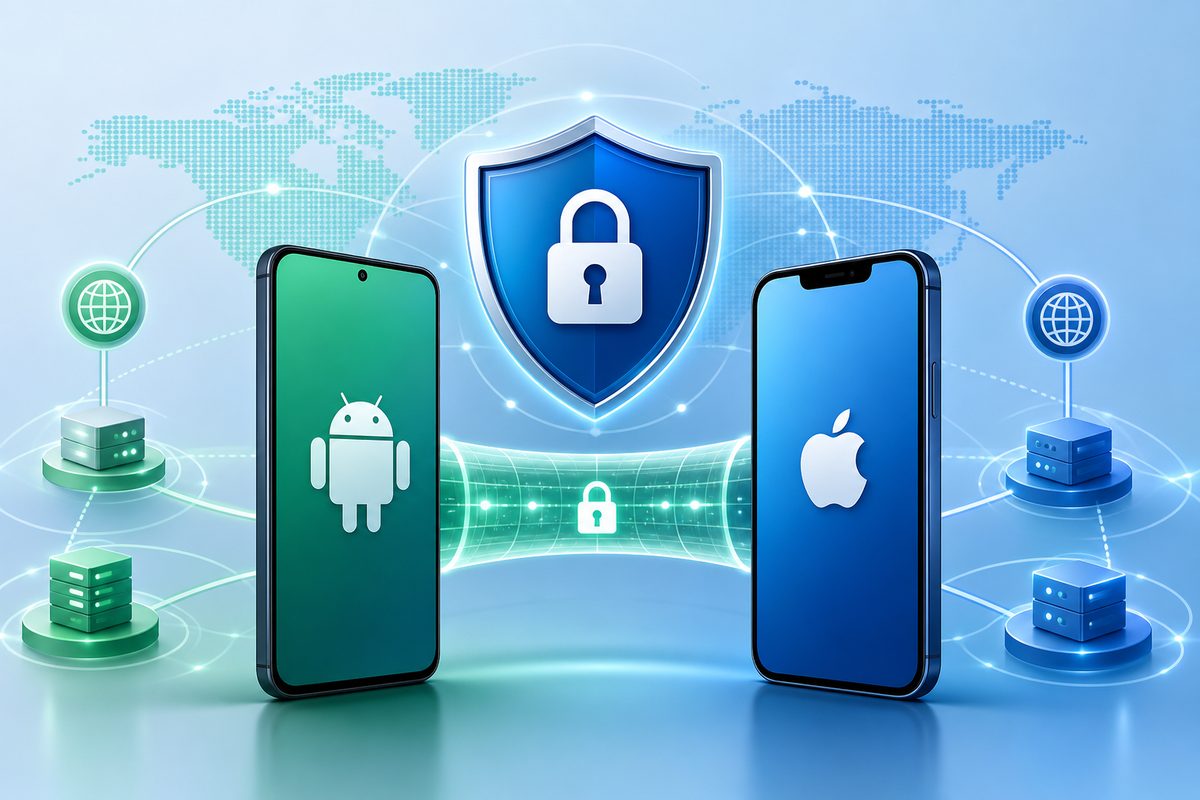
When your VPN is connected but websites only load on the second try, YouTube hangs on the loading screen, Telegram slowly pulls in media, and your banking app suddenly asks you to log in again, the cause isn't always a "bad server." In 2026, neighboring privacy features increasingly get in the way: Android Private DNS, iCloud Private Relay, DNS filters, browser DoH, and UDP/QUIC. Below is a practical order of checks — no risky instructions, no advice on bypassing the law.
> Quick idea: don't turn on every "protective" toggle at once. First build a clear setup where DNS, VPN, and apps aren't fighting over the route.
Why This Topic Matters Now
A modern phone no longer sends all traffic the same way. The browser may use DNS-over-HTTPS, Android may use a system-wide Private DNS over DNS-over-TLS, the iPhone may use iCloud Private Relay for Safari, and the VPN client may use its own DNS inside the tunnel. Each technology is useful on its own, but together they sometimes create a routing conflict.
Apple's iCloud Private Relay documentation explains that Private Relay protects privacy in Safari: DNS records are encrypted, the request goes through two relays, and no single party sees both the user and the site at the same time. This is not the same as a VPN for all apps. In corporate and user-facing Apple discussions, there's also an important nuance: traffic that goes through a VPN may not use Private Relay at all.
For Android, recent Microsoft Learn discussions show a different class of problem: with Private DNS enabled on Android, especially on certain Samsung devices, users experienced DNS resolution failures; turning Private DNS off restored normal behavior. This isn't a universal diagnosis for every phone, but it's a strong signal for a checklist.
There's also a third layer: HTTP/3 and QUIC. LiteSpeed's documentation reminds us that HTTP/3 runs on top of QUIC, and QUIC uses UDP 443. If the network, router, or VPN profile handles UDP poorly, the browser or app may fall back to HTTP/2, slow down, or behave unstably. Hysteria's documentation also stresses: when QUIC has problems, switching to HTTP/2/TCP often helps, because QUIC is encrypted UDP packets that intermediaries cannot "fix" the way they fix regular TCP.
Symptoms: When to Suspect DNS, Not the VPN Server
| Symptom | More Likely Cause | What to Check First |
|---|---|---|
| VPN is connected, but sites only open after several refreshes | DNS timeouts or Private DNS conflict | Turn off Private DNS for 5 minutes and retry |
| Telegram/YouTube load text, but media hangs | UDP/QUIC, route, or app DNS cache | Switch Wi‑Fi/LTE, then change VPN protocol |
| Safari behaves differently from Chrome or the app | iCloud Private Relay or browser DNS | Check Private Relay and DNS in the browser |
| Banking and government apps demand a fresh login | IP/geo change, extra VPN route | Open such services without VPN or via an exception |
| Android shows "Private DNS server cannot be accessed" | DNS-over-TLS provider unreachable | Disable Private DNS or switch to automatic mode |
Important: these signs don't prove the cause with 100% certainty. They help you quickly separate "the VPN server went down" from "the phone is steering DNS somewhere else."
How the Conflict Works, in Plain Words
Imagine three dispatchers trying to decide where to send a request at the same time:
- The VPN client wants DNS and app traffic to go through the tunnel.
- Private DNS on Android wants to send DNS to its configured DNS-over-TLS server.
- Private Relay or browser DoH may separately protect Safari/browser queries.
If all three are on, an app may get the site's IP address via one path and connect to it via another. Sometimes this is invisible. Sometimes timeouts appear because the DNS provider is unreachable from the current network, the router throttles UDP, the VPN doesn't intercept the relevant query type, or the site sees an unexpected IP change.
For an average user, the best approach is not to hunt for a "magic setting" but to temporarily simplify the picture: keep one VPN, one DNS logic, and one test scenario.
10-Minute Diagnostic Checklist
- Record the baseline: device, Android/iOS version, Wi‑Fi or LTE, the app, and the time of the failure.
- Test without the VPN: does the same site or app open without a tunnel?
- Test with VPN but without Private DNS: on Android, temporarily set Private DNS to "Automatic" or "Off."
- On iPhone, check iCloud Private Relay: if the issue only appears in Safari, temporarily disable Private Relay for that network and retest.
- Compare browser and app: for example, the site opens in Chrome but not in the service's app — that suggests a DNS cache or app protocol issue.
- Switch networks: Wi‑Fi → mobile or vice versa. If the issue disappears, the router, carrier, or in-network DNS filter may be the culprit.
- Change VPN protocol/server: only after the DNS check. Otherwise you may mistake random improvement for a real fix.
- Turn settings back on one by one: first VPN, then DNS, then Private Relay/filter. That way you'll see which toggle breaks the setup.
Android: Where to Find Private DNS
On most Android devices, the path is: Settings → Network & Internet → Private DNS. Different skins may call it "Personal DNS," "Secure DNS," or bury it inside advanced network settings.
A practical sequence:
- Open the Private DNS settings.
- If a specific DNS provider hostname is set, write it down.
- Switch the mode to "Automatic" or "Off" for testing.
- Restart the VPN connection.
- Open the same site in a browser and the relevant app.
- If things improve, the conflict is almost certainly about the DNS route.
If you're using a corporate phone, an MDM profile, Defender/Global Secure Access, or similar tools, don't remove settings yourself. Microsoft Learn describes exactly this enterprise scenario, where Private DNS was tied to internal names and access policies. For a personal phone, a temporary test is enough; for a work phone, you need an administrator.
Also check our companion guide VPN on Android disconnects on its own: if alongside the DNS issue your VPN also gets killed in the background, the cause may be battery saving rather than DNS alone.
iPhone: iCloud Private Relay, VPN, and Safari
On iPhone, the conflict usually looks different: messengers work fine, but Safari acts strangely; or the opposite — Safari opens sites normally, but an app can't connect through the VPN. That makes sense, because Apple's documentation describes iCloud Private Relay as privacy protection for browsing in Safari, not as a general VPN for every app.
What to check:
- Settings → Apple ID → iCloud → Private Relay: is Private Relay enabled?
- Settings → Wi‑Fi → current network: is there a per-network toggle restricting Private Relay?
- Settings → VPN & Device Management: are there multiple VPN profiles that connect automatically?
- Safari vs. Chrome/app: does the symptom match?
If the issue is only in Safari, turn off Private Relay temporarily as a test. If the issue is in every app, look at the VPN profile, DNS profile, and network. If several clients are installed, keep only one active: two auto-connects often create a "race" where one profile turns on and is immediately overridden by another.
For scenarios where you don't want to push everything through the tunnel, see the separate article on VPN split tunneling. It explains why banks, work services, and media apps are best separated carefully rather than putting the whole system behind a global VPN.
YouTube, Telegram, and QUIC: How DNS Fits In
DNS is responsible for finding a service's address, but after that the app still picks a transport. YouTube, browsers, and many modern services actively use HTTP/3/QUIC over UDP. If UDP 443 is unstable in the network or doesn't travel well over a specific VPN route, the app can lag even when DNS is fine.
A safe user-side test:
- check the same video or chat on a different network;
- switch the VPN server to the nearest stable one;
- if the client lets you pick a protocol, compare UDP mode and TCP mode;
- don't change router-level rules unless you understand the consequences;
- don't install dubious "boosters" or profiles from unknown Telegram channels.
If the issue affects a home TV or the whole apartment, see the basic guide VPN for a router and home internet. It makes it easier to tell when the phone is at fault and when the router's route is.
Which Setup to Keep After Testing
For most users, this model works best:
| Scenario | Recommended Setup |
| Personal phone, one
Use the smallest safe checklist
Open Foli, refresh the subscription and test one network and one route before changing everything.